Key points
- Situational Awareness sold its public stock book in one block trade. Bloomberg and Reuters name the buyer as Ken Griffin's Citadel.
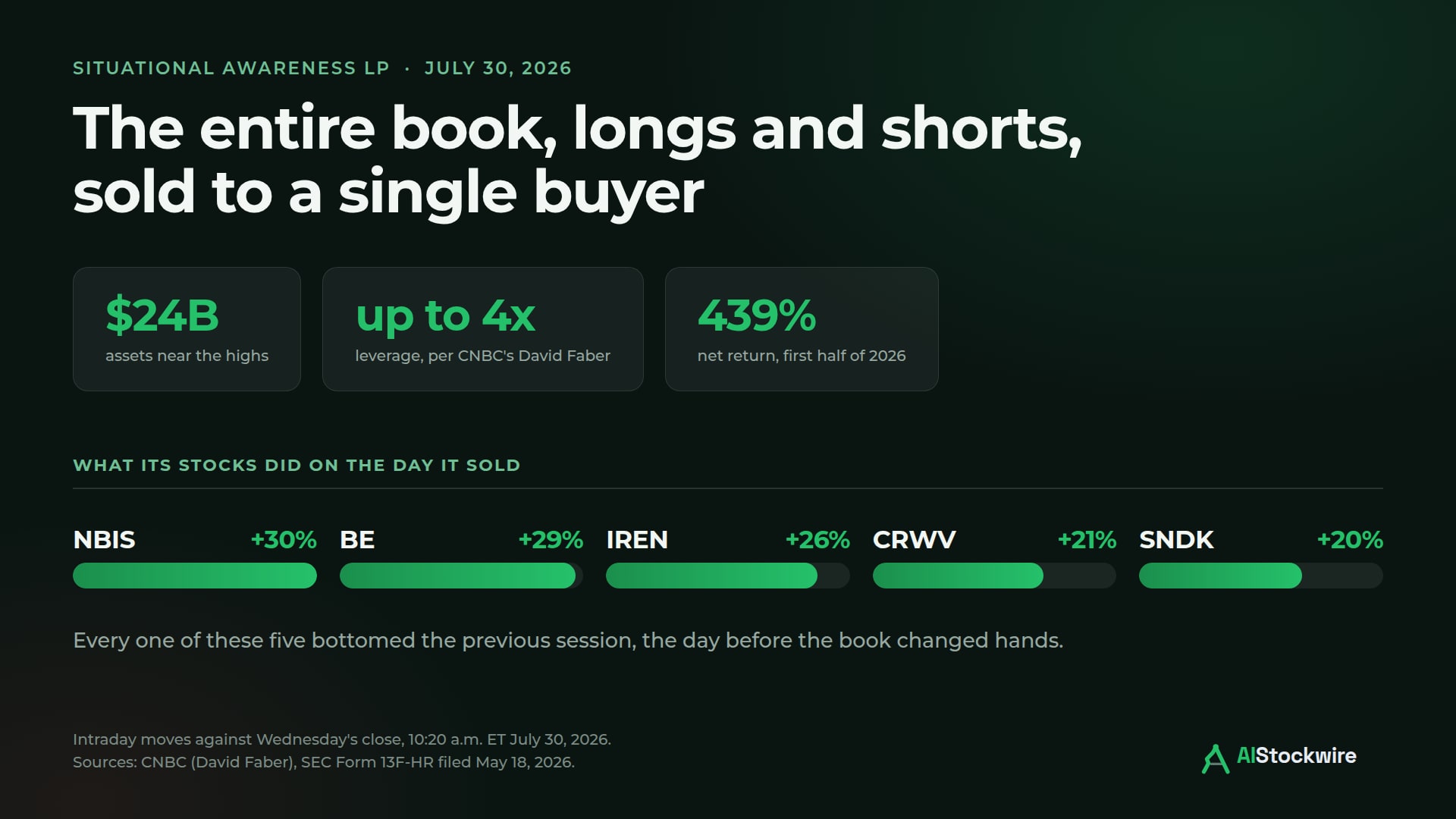
- Faber put the fund at $24B near its highs and described it as levered as much as four times.
- The book changed hands on a day the stocks in it jumped, with Nebius (NBIS) up 30% and Bloom Energy (BE) up 29% by late morning.
- Its last public filing, dated March 31, carried $8.46B of $13.68B (62%) as put options on Nvidia (NVDA), Oracle (ORCL) and other chip names.
Update, July 30, 1 p.m. ET: Bloomberg and Reuters have named the buyer. It is Ken Griffin's Citadel, which both outlets say bought the bulk of the stock book. A Citadel representative declined to comment. Note the word bulk: Bloomberg also reports that Situational Awareness still holds some public stock, which sits a little apart from the account below. We walk through the gap, and the SEC deadlines that close it, here.
Update, July 30, 10:20 a.m. ET: This piece has been rewritten. It first published as a story about a fund asking its investors for cash. Within the hour, CNBC's David Faber reported that Situational Awareness had exited its entire public equities book, the longs and the shorts together, in one block trade to a single buyer.
A fund that gained 439% in six months doesn't usually spend the seventh one selling everything it owns. That's where Leopold Aschenbrenner ended up on Thursday. David Faber reported that Situational Awareness has exited its entire public equities book, the long positions and the short ones together, in a single block trade to one buyer. The firm itself continues. For now, it holds only private positions.
Thursday began as a smaller story. The Financial Times reported that morning that the roughly $20 billion firm had approached existing investors and its lenders for fresh money after heavy losses in the July selloff in AI stocks, and that some investors were offered the chance to buy holdings straight out of the portfolio. Aschenbrenner started the fund in 2024 after OpenAI fired him.
CNBC then filled in what had been happening underneath. Prime brokers at Bank of America, Goldman Sachs and JPMorgan Chase had been working with the firm to meet margin requirements, and had been marketing its holdings before Thursday's open. Faber put the fund at $24 billion near its highs and described it as levered "as much as four times." That last number is the one that explains the speed of everything else.
The part I keep coming back to is the filing underneath all of this, because it says something the headlines skip. Aschenbrenner is the loudest voice for the idea that AI needs an enormous physical buildout of chips and the power to run them. His last public filing shows he'd spent most of his disclosed money betting against the chip companies.
What the fund actually reported owning
Situational Awareness filed its most recent quarterly holdings report on May 18, covering positions as of March 31. It lists 42 positions worth $13.68 billion. Of that, $8.46 billion sits in put options, which are contracts that pay off when a stock falls. That's 62% of the whole filing, and the five largest lines are all of that type. Put options against the VanEck Semiconductor ETF (SMH) come to $2.04 billion. Nvidia is next at $1.57 billion, then Oracle at $1.07 billion, Broadcom (AVGO) at $1.01 billion and AMD at $969 million. Further down the table, there's more of the same against Micron (MU), Taiwan Semiconductor (TSM) and ASML.
One number needs a caveat before anyone runs with it. The dollar figure on an options line in these filings is the value of the underlying shares. That's a separate thing from what the fund paid for the contracts. Nvidia's line covers 8,992,300 shares at about $174 each, which is where the $1.57 billion comes from. The actual cash at risk is the premium, a figure the form leaves out. So $8.46 billion is the size of the bet. The size of the check is smaller and unpublished.
The stock the fund held outright came to $3.86 billion, and it reads like a completely different portfolio. Bloom Energy at $879 million, SanDisk (SNDK) at $724 million, CoreWeave (CRWV) at $556 million, then smaller stakes in IREN, Core Scientific (CORZ), Applied Digital (APLD) and two bitcoin miners. That half of the book is where the electricity and the memory chips actually live.
Put the two halves together, and the shape is clear enough. He owned the equipment and the power. He'd also built large positions that would pay off if the famous chip names fell. Both halves were sold on Thursday.
The chip bets paid. The rest paid more, in the wrong direction
July delivered the chip decline he'd positioned for. The sizing is where it went wrong. Using daily closing prices from June 1 through Wednesday, Oracle fell 53% from its June peak, which made his third largest bet against the group a very good one. His two largest sat on the mildest declines in it. The semiconductor fund fell 25% and Nvidia fell 15%. Between them, those two lines carried $3.6 billion of the $8.46 billion.
The stocks the fund owned outright had a worse month than any of that. SanDisk fell 57% from its June peak to Wednesday's close, Bloom Energy fell 53%, Applied Digital fell 52% and CoreWeave fell 51%. Every one of them bottomed on Wednesday, the day before the exit.
That gap is the whole problem, and it's arithmetic. A 15% decline in Nvidia and a 57% decline in a memory company are different events, even arriving in the same week for the same reason. Add Faber's leverage figure of up to four times, and a drawdown of that size in the long book stops being painful and starts being terminal. CNBC also described a second wound that sits outside any quarterly filing. The fund had bets against software companies including Adobe (ADBE), and those moved against it. Bets against a stock itself stay off these forms entirely. The only reason anyone knows about the Adobe side is that reporters were told.
Two positions the March filing predates
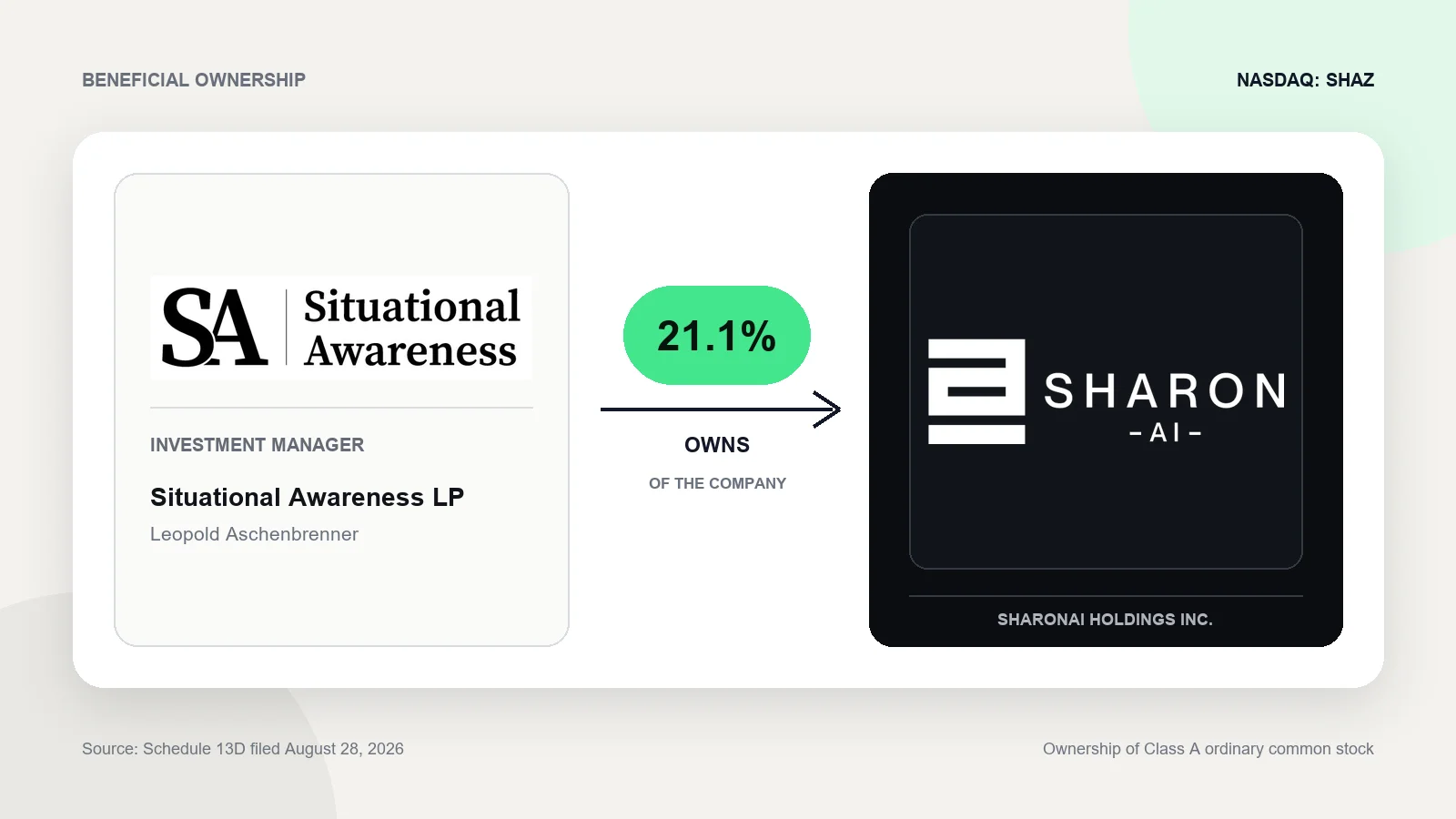
Two later filings cover ground the quarterly report predates. On May 27, the fund disclosed 12,410,060 Class A shares of Nebius Group (NBIS), or 5.6% of the company. That name appears nowhere in the March 31 filing. At the stock's June 18 peak close, the stake was worth $3.56 billion. At Wednesday's close, it was worth $1.84 billion. If the fund still held all of it, that single position carried a paper decline of $1.72 billion going into this week. On June 29, it disclosed 19.9% of SharonAI Holdings (SHAZ), a small data center company. That position is 1,696,127 shares plus warrants on another 6,374,823, capped just under 20%. A Form 4 filed July 2 shows the fund exercised 3.7 million pre-funded warrants on June 30 at a hundredth of a cent each. Both filings name Carl Shulman alongside Aschenbrenner as a reporting person. Both companies are publicly traded, which puts both stakes inside the book Faber says has now changed hands.
The timing is the strange part
Aschenbrenner sent his half-year letter to investors on July 24. In it, he called the decline a buying opportunity and pointed at a possible Anthropic listing later this year as the next catalyst. Existing investors had until Aug. 1 to put in more. The letter closed with a line that reads differently now than it did six days ago: "PS. At times we call out opportunities that seem like a particularly good time to add funds, if you have been waiting for one."
Then Wednesday happened, and the names in his portfolio put in their lows. On Thursday morning, with the brokers already marketing the book, those same stocks went the other way hard. By 10:20 a.m. Eastern, Nebius was up 30%, Bloom Energy 29%, IREN 26%, CoreWeave 21% and SanDisk 20%. Nebius had agreed to sell more than $1 billion of computing to Reflection AI through 2029. Alphabet had raised its 2026 capital spending forecast to between $195 billion and $205 billion. Adobe, the software bet that had been running against him, fell 7%.
So the book changed hands on the morning almost everything in it rebounded, and on the morning the one position working against him finally turned. The price the block traded at has not been reported, and a portfolio that size rarely moves at the screen price. What is fixed now is the sequence. The lows were Wednesday. The exit was Thursday.
What the filings leave out
The filings leave out quite a lot, starting with the number everyone wants. The size of the drawdown hasn't been disclosed anywhere. The $20 billion in the FT report and the $24 billion Faber cited describe different moments, so treat both as approximate. Citadel has since been named as the buyer, though the price remains undisclosed. Whether any investor or lender put in new money before the sale went through is also unreported.
The holdings above are also four months old, and that gap is about to get strange. The next quarterly filing, covering June 30, is due in mid-August, and it will show a portfolio that no longer exists. The one after that should be close to empty on the public side. Both will omit the bets against software that CNBC says did real damage, because bets made by borrowing and selling a stock stay off these forms.
The documented part is narrower than the headlines and more useful than them. A fund built on the argument that AI needs an enormous physical buildout put 62% of its reported book into contracts that pay when chip stocks fall. It owned the power and the memory behind that buildout with the rest, at up to four times leverage. Then it watched the stock it owned fall about twice as far as the two chip lines it had bet the most against, and then sold all of it to one buyer on the morning the rebound arrived.
For the raw documents, our Nebius stock and filings page tracks new SEC paperwork as it lands. We wrote up Nebius and its $775 million loan earlier this month, and Bloom Energy's 2.45 GW riding on an Oracle site the week before. If you're tempted to copy any of this, our look at whether copying hedge fund disclosures actually works is worth reading first. And Michael Burry cutting his own Oracle bet in half shows how fast these positions change between filings.
Sources
- Bloomberg and Reuters, July 30, 2026: Ken Griffin's Citadel bought the bulk of Situational Awareness's stock positions; a Citadel representative declined to comment; Bloomberg reports the fund has not sold all of its public stock and retains private stakes including Anthropic.
- CNBC, David Faber, July 30, 2026: Situational Awareness exited its entire public equities book, longs and shorts, in a single block trade to one buyer; $24 billion near the highs; levered as much as four times; the firm continues with private holdings only.
- CNBC, July 30, 2026: prime brokers at Bank of America, Goldman Sachs and JPMorgan Chase working with the firm on margin and marketing its holdings before Thursday's open; bets against software including Adobe.
- Financial Times, July 30, 2026: the firm approached existing investors and lenders for fresh money; investors offered portfolio assets; the July 24 letter and Aug. 1 deadline.
- SEC filings by Situational Awareness LP: Form 13F-HR filed May 18, 2026 (positions as of March 31, 2026), Schedule 13G on Nebius filed May 27, 2026, Schedule 13G on SharonAI filed June 29, 2026, and Form 4 filed July 2, 2026.
- Daily closing prices June 1 through July 29, 2026, and intraday quotes as of 10:20 a.m. ET on July 30, 2026.