Key points
- Korean retail investors put $798 million into the Direxion Daily Semiconductor Bull 3X Shares (SOXL) from August 21 to 27.
- Nvidia (NVDA) reported earnings on August 26, and the same investors put about $14 million into the stock itself that week. SOXL took in about 58 times more.
- SOXL fell 9.49% on August 28, the first session after that buying week ended.
Maeil Business Newspaper (매일경제) published the weekly overseas-stock rankings in Seoul on August 29, and one number stood out. Korea Securities Depository (한국예탁결제원) data showed that Korean retail investors bought $798.04 million of the Direxion Daily Semiconductor Bull 3X Shares (SOXL) between August 21 and 27, more than any other overseas stock.
What caught me was how small Nvidia (NVDA) looked next to it. The market spent the week waiting for Nvidia's earnings, yet Korean investors put just $13.87 million into the stock, placing it 36th in the ranking. SOXL received about 58 times that amount. It is a leveraged fund designed to move three times as much as the semiconductor index each day.
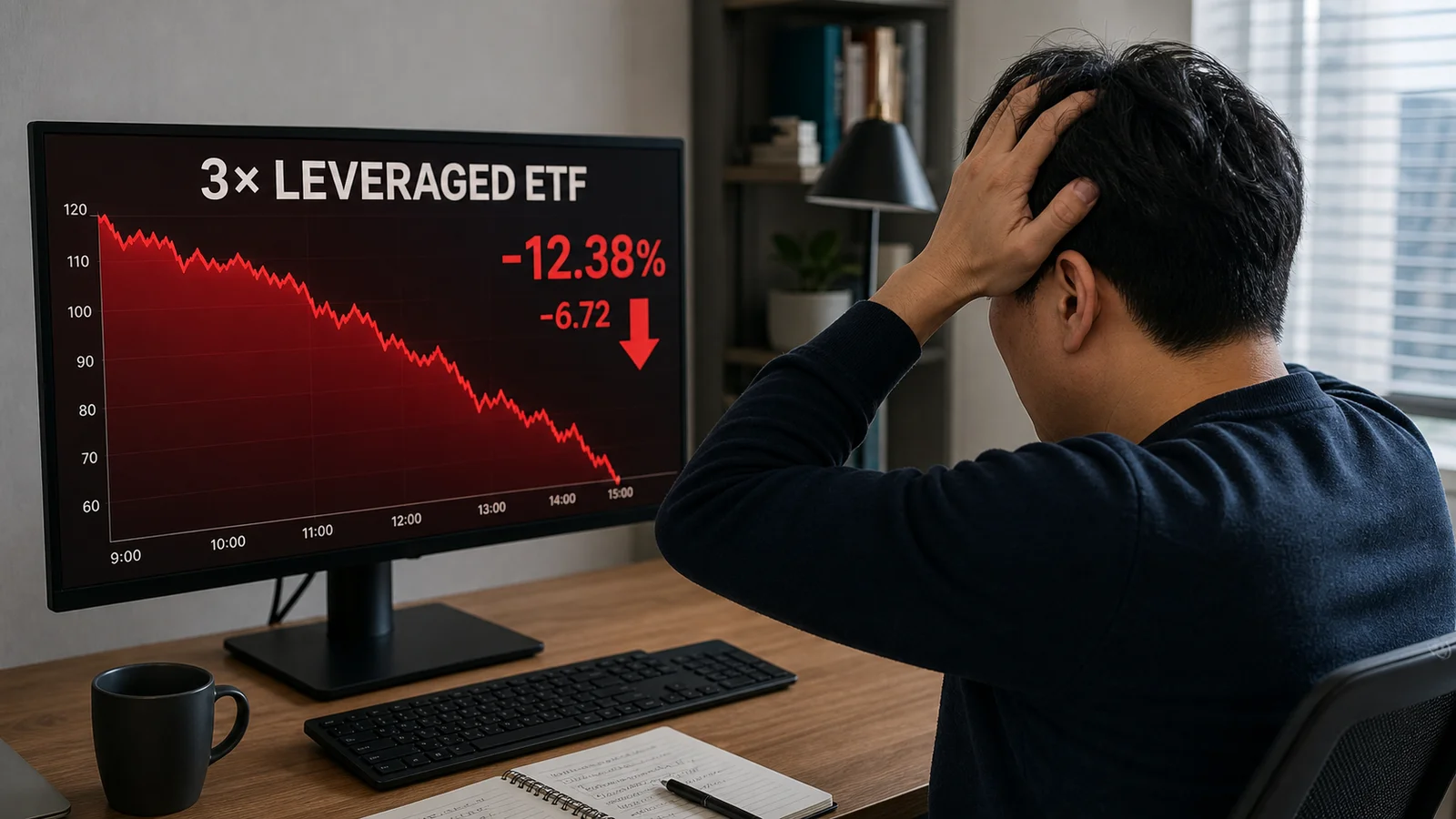
Korean media calls these investors seohak-gaemi (서학개미), which stands for "ants" who buy overseas stocks, the same ants who sent $4.6 billion to US stocks in July. They had a rough Friday. SOXL tries to deliver three times the daily move of the NYSE Semiconductor Index, before fees. On August 28, the iShares Semiconductor ETF (SOXX), which follows the same index without leverage, fell 3.22%. Three times that would be 9.66%. SOXL closed down 9.49%, at $111.37 from $123.05 the day before, with the small difference coming from fees and the daily cost of running the leverage.
Nvidia reported its quarter after the US close on August 26 and beat what analysts expected, with earnings of $2.22 a share against a $2.09 estimate. The stock rose 8.74% the next day, and then gave back 4.58% on Friday.
The paper listed the week's semiconductor and leveraged-fund purchases, and leverage is everywhere in it.
| Security | Net purchases, Aug 21 to 27 | Rank |
|---|---|---|
| Direxion Daily Semiconductor Bull 3X (SOXL) | $798.04 million | 1 |
| ProShares Ultra QQQ (QLD) | $44.82 million | 9 |
| ProShares UltraPro QQQ (TQQQ) | $43.99 million | 10 |
| Broadcom (AVGO) | $42.38 million | 12 |
| SanDisk (SNDK) | $24.75 million | 21 |
| Roundhill T-REX 2X Long DRAM (RAM) | $20.98 million | 25 |
| Marvell Technology (MRVL) | $15.71 million | not stated |
| Nvidia (NVDA) | $13.87 million | 36 |
| Intel (INTC) | $11.59 million | not stated |
| ProShares Ultra Semiconductors (USD) | $7.61 million | 49 |
Four of the ten are leveraged funds. The Roundhill T-REX 2X Long DRAM Daily Target ETF (RAM) is only a few months old, launched in June, and it tries to deliver two times the daily move of a fund that holds memory-chip companies. Korean investors put $20.98 million into it, good for 25th place.
The monthly list doesn't show SOXL at all
When Maeil Business Newspaper widened the window to the full month of August, SOXL was missing from the top 50 entirely. A fund can only rank first for the week and miss the monthly list if investors sold it hard earlier in August, enough to cancel out the $798.04 million. That's my reading of the two rankings, not a number the depository published. The buying came in a rush, in the days before and right after Nvidia's report.
Holding a daily 3x fund is not like holding the index
SOXL resets its leverage every day, so over weeks it doesn't return three times what the index returns. When the market moves up and down without really going anywhere, the daily resets wear the fund down. From July 16 to August 27, SOXX fell 0.96%. SOXL fell 13.6% over the same stretch. Same index, same dates, and the leveraged fund lost about 14 times as much.
The ants have already lived through this once this summer. Sisa Journal (시사저널) reported earlier, using the same depository data, that Korean investors bought about $3.77 billion of SOXL across June and July, while the value of their US stock holdings fell by 48.67 trillion won ($33.7 billion USD) from May 30 to July 30. SOXL went from $224.34 on May 29 to $114.72 on July 30, a drop of 48.9%.
Kim Jae-seung (김재승), a researcher at Hyundai Motor Securities (현대차증권), told the paper that money crowding into single-stock leveraged products "can become a factor that expands market volatility." The report also noted that regulators in Korea are tightening rules on repeated in-and-out trading of these products.
Sources
- 매일경제, report on the Korea Securities Depository weekly net purchase rankings, August 29, 2026, for the net purchase figures and the analyst comment
- 시사저널, report on Korean investors' US stock holdings, for the June and July SOXL purchases and the fall in holdings
- Direxion, Daily Semiconductor Bull and Bear 3X ETFs, for the fund's objective and fees
- Closing prices for SOXL, SOXX, Nvidia, and RAM are market data as of the August 28, 2026 session
The analyst comment is translated from Korean. This is general market commentary and opinion, not investment advice. Markets can go down as well as up, and you can lose money. Always do your own research and consider speaking with a licensed financial professional before making any investment decision.