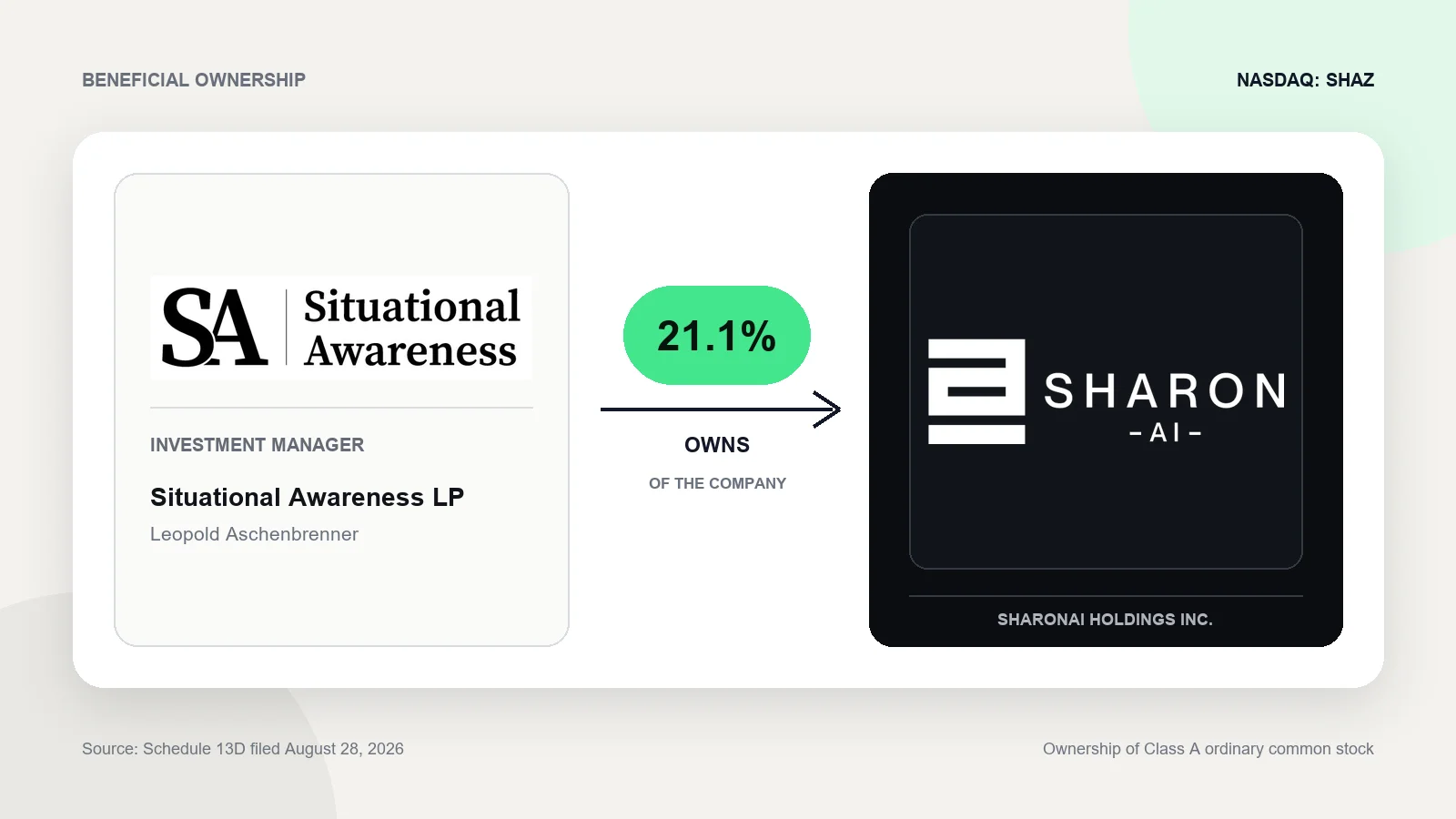
Leopold Aschenbrenner's fund owns 21.1% of SharonAI (SHAZ). It's currently sitting $101 million below cost.
Situational Awareness filed a Schedule 13D reporting 8,070,950 SharonAI (SHAZ) shares at a cost of $523.9 million. The same position was in its filings before the fund's July losses, and it's still there.
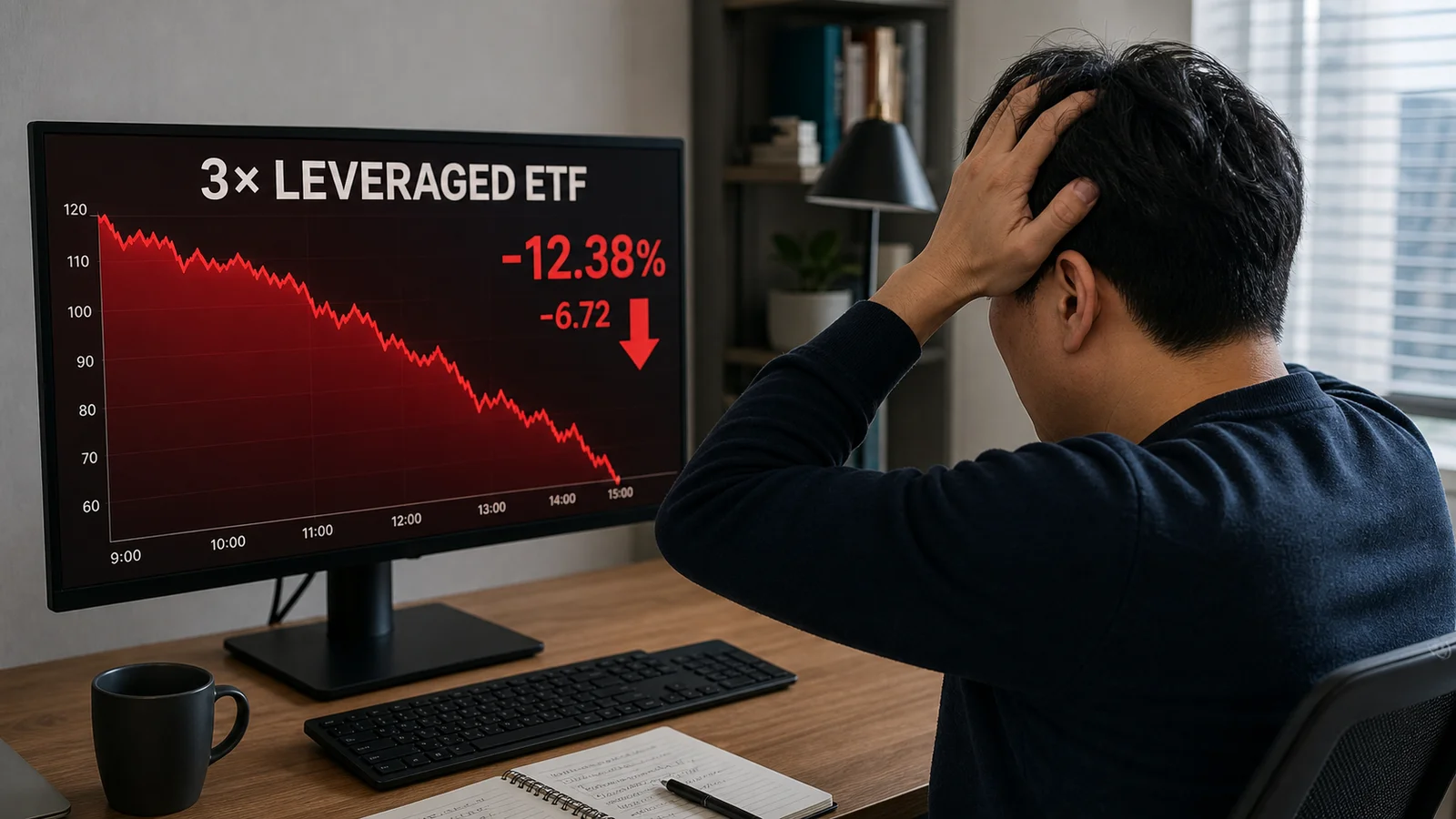
Korean investors put $798 million into a 3x leveraged semiconductor fund (SOXL) in one week. It fell 9.5% the next session.
Korean investors made a 3x semiconductor fund their number one overseas purchase in the week of Nvidia's earnings, with $798.04 million going in. That's about 58 times what they put into Nvidia itself.
China's top DRAM maker ChangXin (CXMT) lost money a year ago. It just earned $10.8 billion in six months
China's largest DRAM maker reported 150.31 billion yuan ($22.4 billion) in first-half revenue, up 873.6%, with profit 36% above its own IPO forecast.
Kioxia plans a $6.3 billion new memory plant in Japan, Nikkei reports
Nikkei says Kioxia plans to invest about $6.3 billion in a new memory plant in Japan for AI data-center demand. There is no US Kioxia ticker; Sandisk (SNDK), Western Digital and Micron are the proxies.
The SEC subpoenaed four Wall Street banks over the Situational Awareness meltdown, the New York Times reports
Bank of America, Citigroup, Goldman Sachs and JPMorgan Chase were told to preserve records on Leopold Aschenbrenner's fund as regulators examine trade timing and leverage from its near collapse in July.
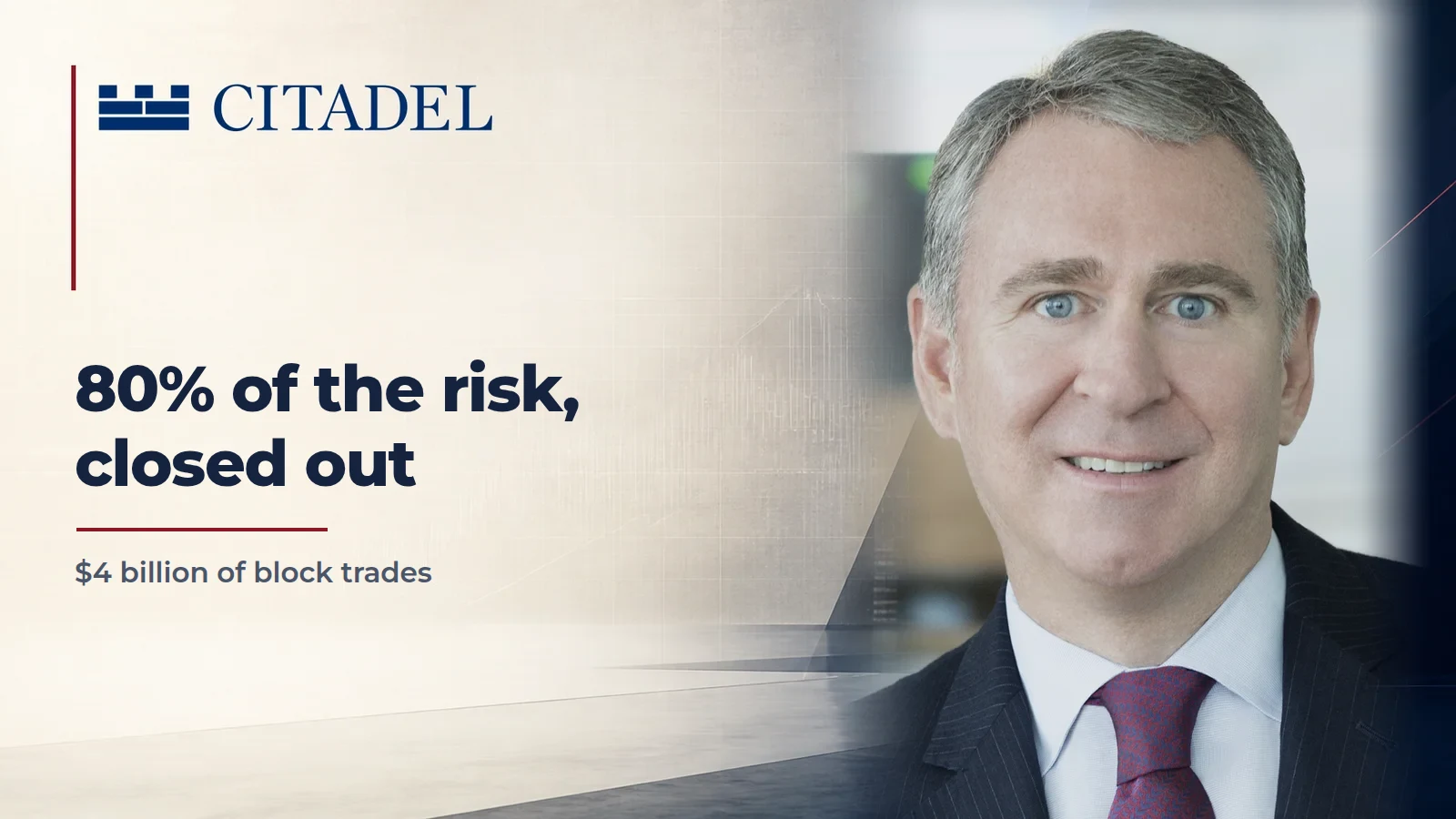
Ken Griffin says Citadel has closed out 80% of Leopold Aschenbrenner's Situational Awareness risk
Griffin's first comment on the Situational Awareness purchase came in a Friday letter to clients. It took more than 100 block trades over $4 billion of market value to retire four fifths of the risk.
Memory chip prices are soaring. So why are Micron (MU), SanDisk (SNDK) and SK Hynix (SKHY) falling?
Korea's chip exports nearly tripled in the first 20 days of August and its semiconductor export price index has quadrupled since 2023. Micron, SanDisk, SK Hynix, Samsung and Kioxia all peaked within one week in June and have fallen 21% to 51% since.

Leopold Aschenbrenner's latest filing shows he closed 13 of his 16 options positions and moved more than half his fund into SanDisk and Micron
Situational Awareness LP reported $8.46 billion of put positions on March 31 and one on June 30. The money went into SanDisk, Micron, Nebius and STMicroelectronics.

The AI trade rotates to a new sector every week. Which one is it going to be this week?
The AI trade has rotated by sector almost every week: software, then photonics, then memory. So which corner of AI runs next? I make the case for the one group that keeps riding along without ever leading.

Hedge Fund Citadel already held every stock in Leopold Aschenbrenner's book before buying it
Citadel's own quarterly filing, out Friday, already listed every stock in Leopold Aschenbrenner's book, about a month before it bought the book. The catch is what those holdings actually mean.
Memory is the bottleneck for AI, and the shortage is real
Elon Musk amplified a post calling memory, not compute, the limit for AI, and memory stocks ran. The shortage is real: demand is growing far faster than supply, and the new SK Hynix and Micron plants do not open until 2027 and 2028.
Kioxia spent its entire $5 billion buyback in six trading sessions
Kioxia had until October 30 to spend $5.0 billion buying its own stock. It finished on August 10, six sessions in, at an average of 49,586 yen ($312 USD) a share. Toshiba sold into day one and lost the largest shareholder spot. What the pace and the September guide say for SanDisk (SNDK) and Micron (MU).
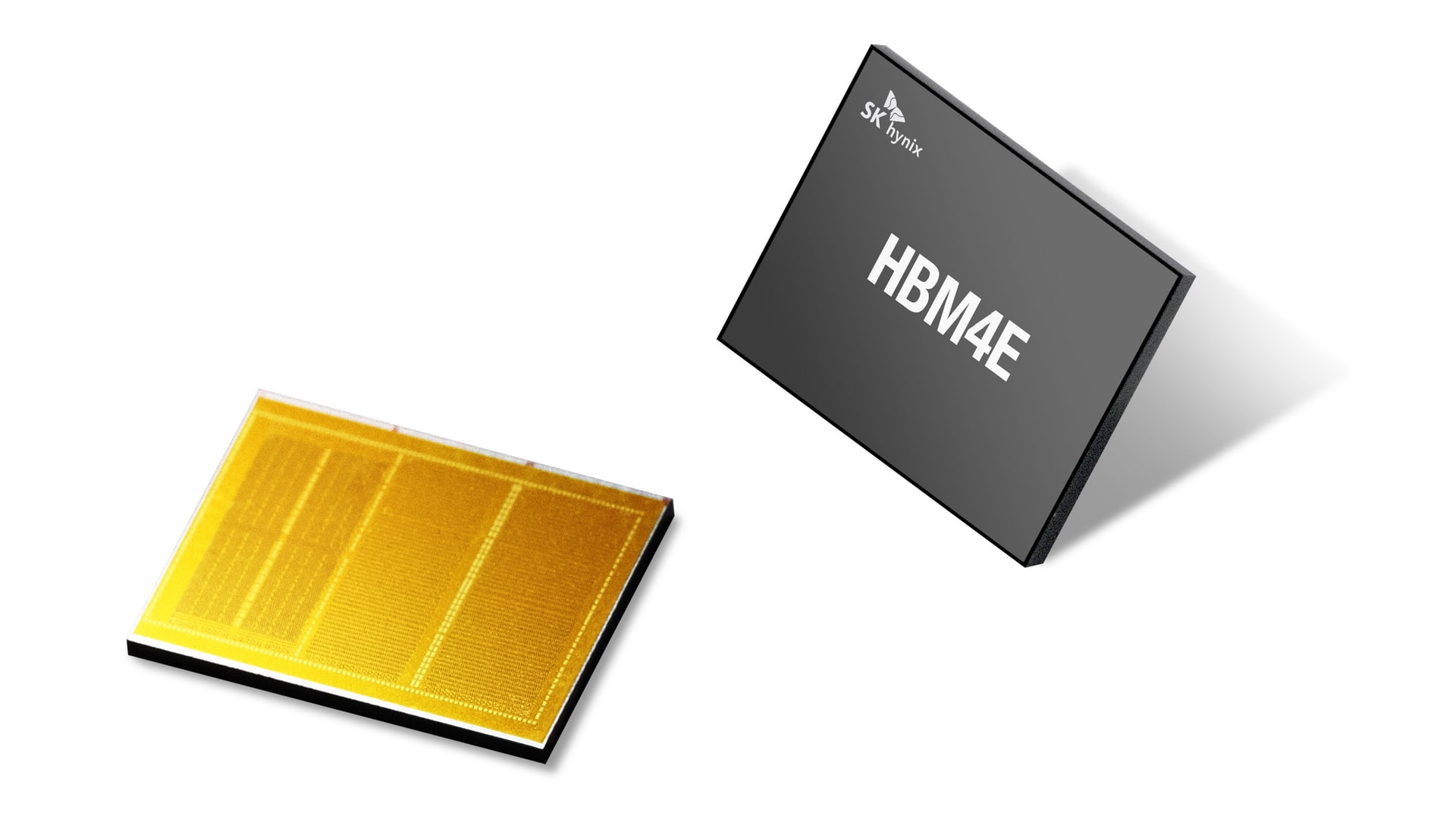
Musk says memory demand grows 200% a year against 20% supply. The new Micron (MU) and SK Hynix (SKHY) plants open in 2027 and 2028
Elon Musk did the memory math out loud on SpaceX's call: supply up 20% a year, demand up 200%. Microsoft put $25 billion of its capex on memory and Amazon named it too. The plants that would fix it open in 2027 and 2028.
CoreWeave (CRWV) secured priority SSD supply from SK Hynix's Solidigm in a multi-year deal, but key terms weren't disclosed.
CoreWeave announced a multi-year agreement with Solidigm for priority access to enterprise SSD capacity. The release carried no dollar value, no term length and no capacity figure, which is not how CoreWeave's $21 billion Meta agreement read. Enterprise SSD contract prices rose about 80% in the first quarter.
The AI trade rallied Monday. Memory fell as much as 8% at the open even as chip prices kept rising.
Micron (MU) has lost a third of its value since June 25 and SanDisk nearly half. CoreWeave and Vertiv fell about half as far, and Nvidia rose. Memory contract prices never fell. What changed is the rate of increase, which went from 93-98% a quarter to a forecast 13-18%.
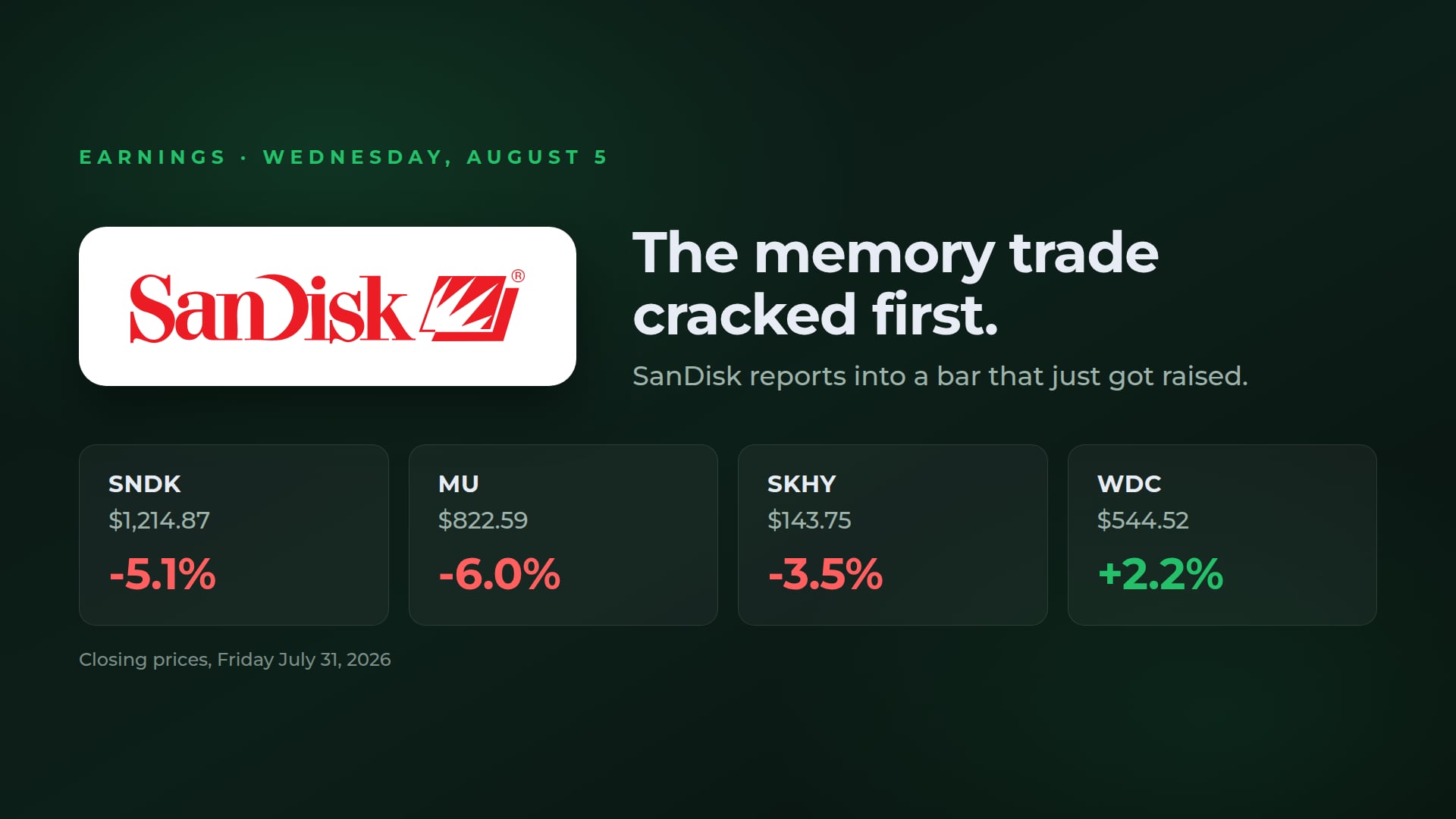
SanDisk (SNDK) beat every line and guided way above consensus. The stock fell anyway.
SanDisk (SNDK) reports fiscal Q4 on August 5 with Goldman's target at $2,200 and the stock at $1,214.87 after a 5.1% Friday drop. SK Hynix printed a 76% operating margin on July 29 and Seoul still closed down 9.61%, because revenue missed consensus by 5.5%.
You cannot buy China's CXMT in the US. You can buy the Roundhill Memory ETF (DRAM), which has $627 million riding on it.
The Roundhill Memory ETF (DRAM) added a $627.5 million CXMT total return swap at a 2.52% weight, five days after CXMT's Shanghai listing. The position is bigger than GigaDevice, and there was no CXMT line in the fund's July 23 file.
Kioxia is the memory chip maker that passed Toyota as Japan's most valuable company, then fell 66%. Here's who owns it
Kioxia is the former Toshiba Memory, and it makes NAND flash and nothing else. Toshiba still holds 15.10% and keeps selling, an SK Hynix (SKHY) vehicle holds 14%, and Sandisk (SNDK) co-owns the factories. What the company makes, who owns it, and how a US investor can reach it.
Nine Aschenbrenner stocks report earnings Aug. 4 to 6, led by SanDisk (SNDK). Nobody can say which six are still his.
Citadel bought the fund's public stock book on July 30. Six of the names in its last itemized filing report earnings between Tuesday and Thursday, and no filing yet says who owns them.
Leopold Aschenbrenner's Situational Awareness fund owned 19 stocks outright. Every one of them rose Thursday after he sold his positions
Four SEC filings name 19 companies Situational Awareness owned outright, and every one of them rose on July 30. Nebius was the biggest at about $1.84 billion, and the quarterly report understates SharonAI by twelve times.

The Nasdaq fell six days straight, then chips ripped. Microsoft, Samsung, and Citadel buying out Aschenbrenner all landed inside 18 hours.
The Nasdaq's six-day losing streak ended at exactly six, which our own history piece said was the single most likely outcome. Microsoft's $678 billion backlog, Samsung's call that the chip crunch runs to 2028, and Citadel buying the bulk of a leveraged $24 billion book all arrived between Wednesday's close and Thursday afternoon.
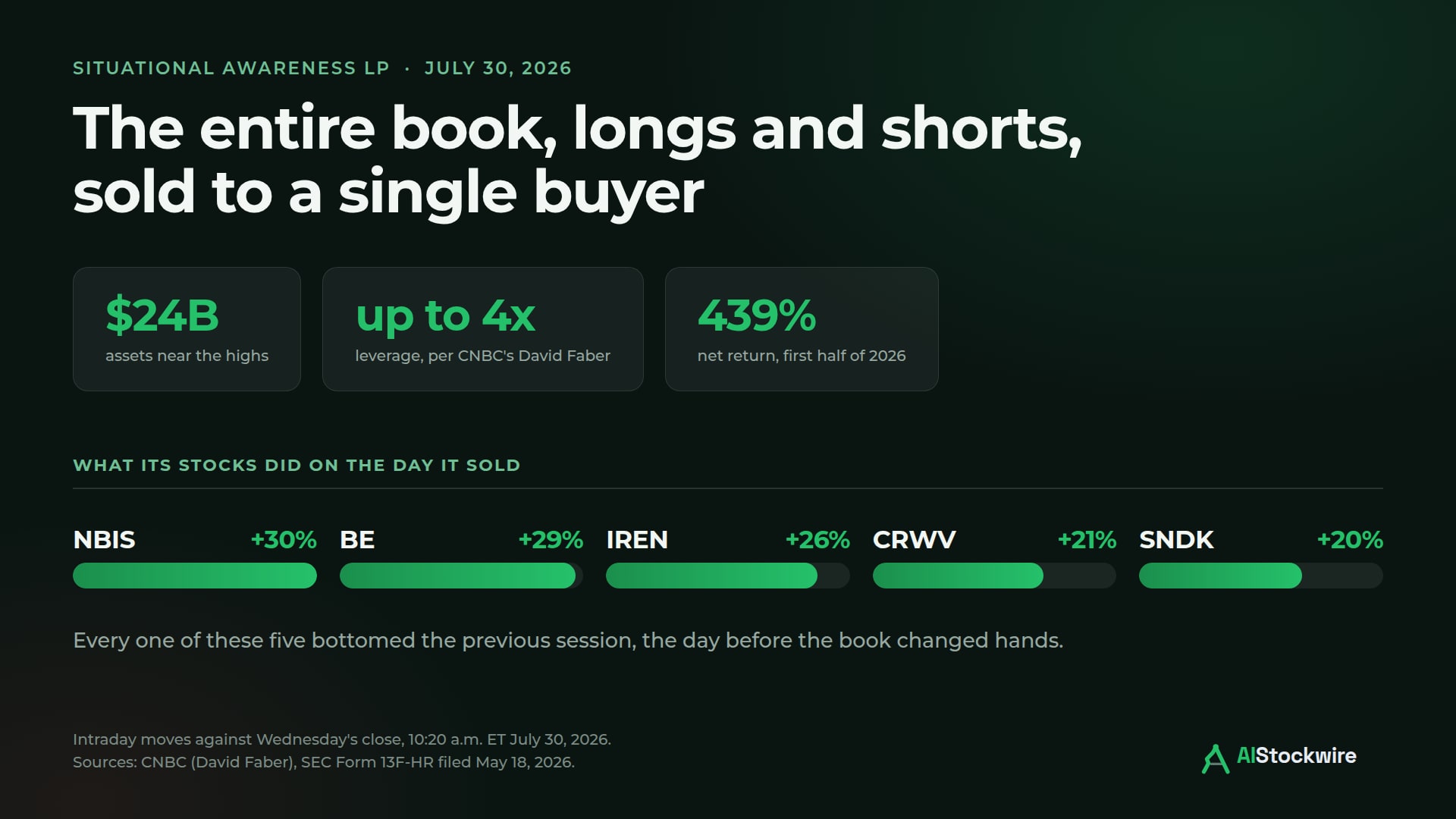
Leopold Aschenbrenner's AI fund sold its levered stock book, longs and shorts, to a single buyer. It was levered as much as four times.
CNBC's David Faber reported that Situational Awareness sold its entire public equities book, longs and shorts together, to a single buyer. The fund reached $24 billion near its highs and ran leverage of as much as four times. Its last public filing shows 62% of a $13.68 billion book was bets against chip stocks, and the stocks it owned outright fell twice as far.
The Nasdaq is down six days straight. We checked what happened next all 85 times, so you don't have to.
The Nasdaq Composite closed lower for a sixth straight session on July 29, finishing at 24,442.94, down 5.4% over the run and 9.8% below its June record. It has happened 85 times since 1971. One month after those streaks the index gained a median 1.5%, which is exactly what a random month returns, and at three months it actually underperformed. The averages hide everything: every streak from 2000 to 2002 was followed by heavy losses, and every streak after 2009 by gains.
SK Hynix (SKHY) reported a record quarter and still missed. One analyst broke from the pack and called it within a quarter of a percent
SK Hynix reported 60.5426 trillion won ($41.6 billion USD) of operating profit against a 64.09 trillion won consensus, 5.5% short, on revenue 5.6% short. Both figures are records. The operating margin came in at 76%, right where the street had it, so the entire miss was revenue rather than profitability. Korea Investment & Securities was the only firm below the pack and landed within a quarter of a percent.