Key points
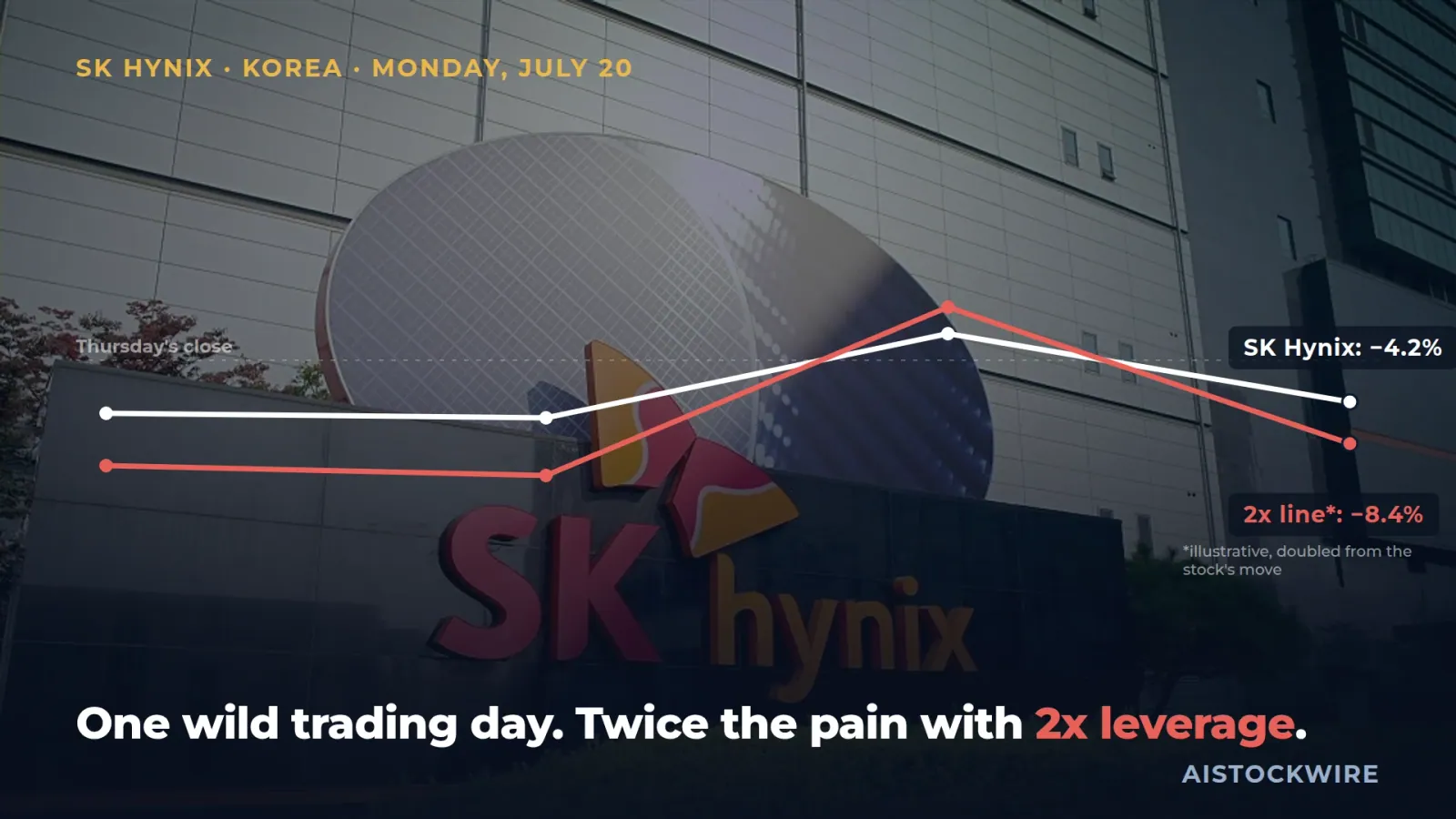
- SK Hynix opened Monday down 5.3%, fell as far as 5.8%, rallied to up 2.7%, then faded to close down 4.2%.
- A 2x leveraged version of that same day would have moved about twice as hard in every direction.
- A stock that falls and then fully recovers still leaves a leveraged position underwater, because the recovery has to be bigger than the drop.
- A new rule takes effect July 31 raising the deposit to trade these products to 30 million won, meant to shrink the market, though two Korean professors doubt it will meaningfully cut future volatility.
SK Hynix's Korea-listed shares, not the Nasdaq ADR trading as SKHY, gave Seoul traders a round trip on Monday that is hard to put into words without a chart. It opened down 5.3 percent. Within the first hour it was down 5.8 percent at the low. By midday it had climbed all the way to up 2.7 percent. Then it gave all of that back and closed down 4.2 percent. The Kospi and Samsung Electronics moved through a similar pattern that day, both clawing back a big chunk of steep morning losses before fading again, and both still closed down more than 4 percent, though Kospi did not cross back into positive territory the way SK Hynix did, though Samsung briefly ticked positive intraday before fading at its best moment.
That is a wild day to sit through holding the regular stock. Now picture holding a 2x leveraged version of it instead.
What 2x actually does to a day like this
I explained the mechanics of these funds here, but the short version is that a single stock 2x leveraged ETF built on the Korea-listed shares is designed to move about twice as much as the stock every single day. These are Korean, KRX-listed products tracking the Seoul-traded stock, separate from the newer US-listed leveraged ETFs that trade against the SKHY ADR. If SK Hynix's low of the day was down 5.8 percent, a 2x product tracking it would have been down closer to 11 to 12 percent at that same moment. If SK Hynix's best moment was up 2.7 percent, the leveraged version would have been up somewhere near 5.4 percent. Same shape, near double the size, in both directions, all in one trading session.
That alone is the easy part to understand. The harder part is what happens after a move like that.
Why going back to even does not mean you are even
Here is the math that catches people. Say a stock drops 5 percent. To get back to where it started, it does not need to rise 5 percent. It needs to rise about 5.3 percent, because the recovery is measured off a smaller number. A small drop needs a slightly bigger bounce to erase it.
Leverage does not just multiply the drop. It multiplies the size of the bounce you now need too, and that distance grows fast. Take SK Hynix's actual low of the day, down 5.8 percent. Climbing back to exactly where it started from that low only needed a 6.2 percent bounce. A 2x product tracking that same low would have been down closer to 11.6 percent at that moment, and a hole that size needs about a 13.1 percent bounce to break even, not the 12.4 percent you would get by simply doubling the stock's own 6.2 percent recovery. The stock needed a 6.2 percent recovery. The leveraged version needed more than double that. Days like Monday, where a stock round trips through a big range and lands lower than where it opened, are exactly the setup that erodes a leveraged position faster than the plain stock underneath it.
A new rule arrives at the end of July. Nobody is sure it fixes this
This is not a one-day story. Starting July 31, the deposit needed to trade these single stock leverage products rises from 10 million won to 30 million won, cash only, with a 20 share minimum purchase. Regulators want the 12 trillion won market for these products to shrink back down toward 4 or 5 trillion won, close to where it stood right after they launched in May. Monday was a clean, live example of exactly the kind of session regulators are trying to prevent, condensed into one trading day instead of spread across weeks.
We covered the backlash to that rule here, including two Korean professors who argue it targets the wrong side of the trade. Their point is worth taking seriously. A higher deposit mostly changes who is allowed to walk in the door, not how many of these products exist or how aggressively they get built and marketed. Less new retail money flowing in after July 31 should mean less fuel for the next sharp move. Whether that is enough to actually stop a day like Monday from happening again is the part nobody can answer yet.
If you are looking at one of these products after a day like Monday and thinking the worst is over because the stock is already down, remember that the leveraged version needed a much bigger bounce than the stock did just to get back to flat, and Monday proved Korean markets are perfectly capable of taking that bounce away again before the closing bell.
Sources
- Kospi, Samsung Electronics, and SK Hynix intraday and closing prices: Korea Exchange real time data via Naver Finance, July 20, 2026.
- Single stock leveraged ETF mechanics and the July 2026 deposit rule: prior AIStockWire reporting, linked above.