Key points
- Update, July 22: SK Hynix formally denied the report below in a Korea Exchange filing, saying it "has not pursued or decided to acquire" Intel's Ohio site.
- SK Hynix was reportedly in talks to buy Intel's stalled Ohio chip campus, sized for up to 8 factories, before the denial.
- Intel budgeted about $28 billion for phase one, then pushed the opening back to 2030 and 2031.
- SK Group chairman Chey Tae-won wants plants "not just in Honam but in America too."
Update, July 22, evening: Hours after this story below was reported, SK Hynix (SKHY) filed a formal denial with the Korea Exchange. The company said it "has not pursued or decided to acquire" Intel's Ohio site, adding that it "continuously reviews various business investment and acquisition opportunities" as a matter of course. A company spokesperson put it more plainly to reporters: "We have no plans for an acquisition." Intel (INTC) separately reaffirmed its own commitment to finishing the Ohio campus. SK Hynix's Seoul shares, which had opened higher on the original report, pared about 4% of their gain once the denial landed. The original report is below, unedited, for the record.
SK Hynix was reported to be in talks to buy the half-built Intel chip campus in Ohio and use it to start making its own memory chips in the United States, according to an exclusive report published Wednesday in Seoul by JoongAng Ilbo, one of Korea's largest newspapers. The goal, per the report, was US production within five years. Nothing was signed. Internal reviews and government approvals were said to still be underway, and the price had not been settled.
A campus built for eight factories, and none of them finished
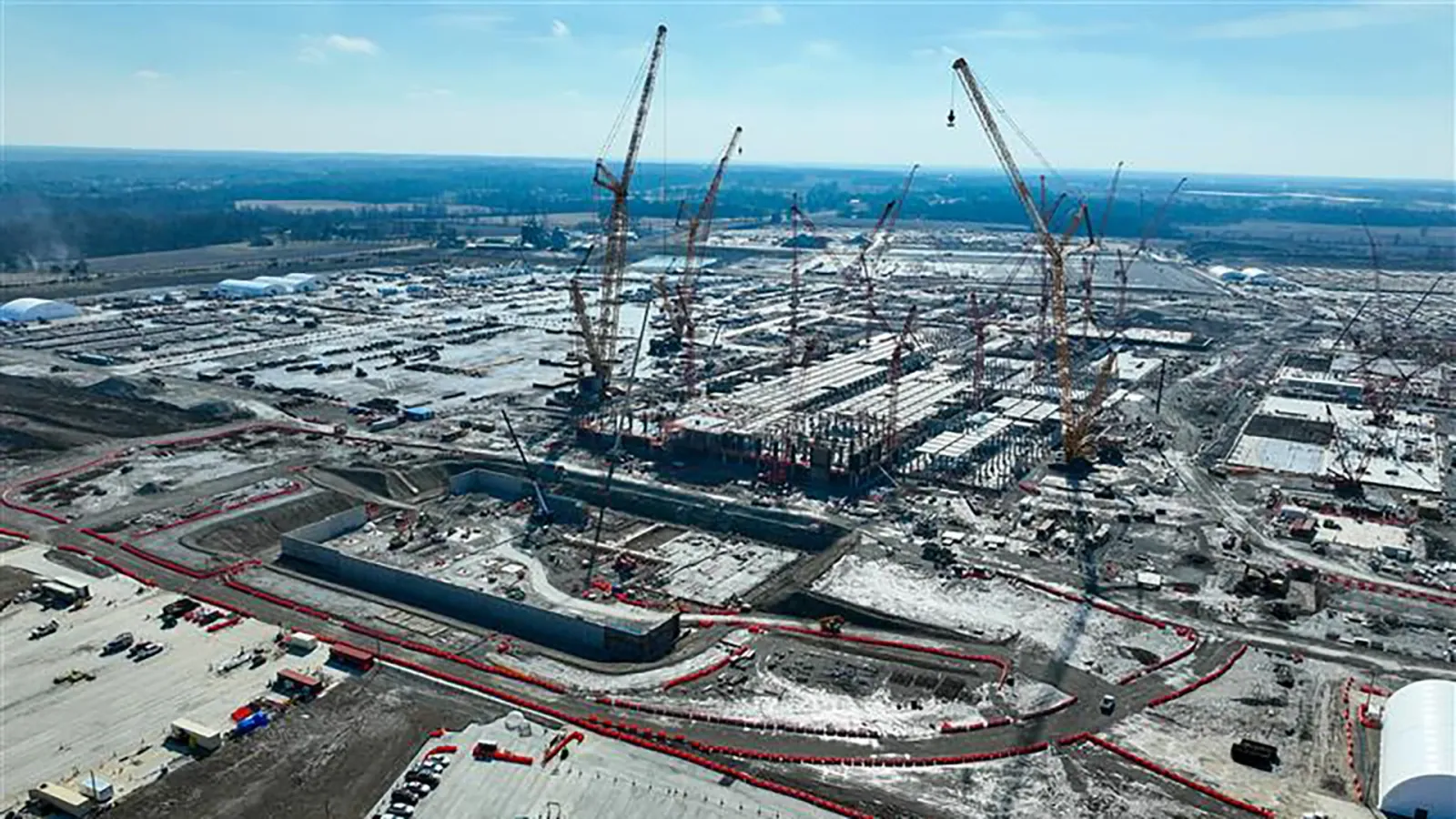
Intel broke ground on the Ohio site in New Albany back in 2022 and described it at the time as a future center of American chipmaking. The land covers about 1,000 acres (1.2 million pyeong in the Korean reporting on this deal), large enough to eventually hold eight separate fabrication buildings. Intel originally budgeted close to $28 billion just for the first phase, with a full buildout that could reach $100 billion over a decade.
None of that has opened yet. Intel has pushed the completion date back more than once. The first building is now not expected to start production until 2030 or 2031, five to six years later than the original 2025 target.
Why Intel might actually sell
The delays line up with a manufacturing business that keeps losing money. Intel Foundry, the company's chip manufacturing arm, lost $10.3 billion in 2025 on $17.8 billion of revenue, then lost another $2.4 billion in the first quarter of 2026 alone. A half-built campus that generates no revenue is an expensive thing to keep sitting on while the rest of the business tries to turn a profit.
The two companies already know each other. Intel hired away Lee Seok-hee, SK Hynix's former CEO, in June to help run its own packaging business, a detail that makes a straight sale between them a little less surprising.
Chey Tae-won's case for building in America
Chey Tae-won, the chairman of SK Group, is quoted in the report making the case plainly. "Memory chip prices are abnormally high right now. We need to expand supply to bring them down. We need factories not just in Honam, but in America too," he said.
The Honam reference is not random. SK Hynix and Samsung Electronics have already committed some 800 trillion won (close to $530 billion) to a new chip cluster in Korea's own Honam region. Chey had already hinted a US site was possible under the right conditions. He told Herald Business something close to this on July 13, more than a week before the Ohio report: if conditions are met, there is no reason not to build in the US.
Washington has been asking for this too
US Commerce Secretary Howard Lutnick said on July 9, at a groundbreaking for a Micron plant in Clay, New York, that he wants to bring Samsung and SK Hynix to the United States and have them build plants. He added that Micron's own expansion means its Asian rivals have no choice but to follow. Micron, the only major US-based memory maker, has said it will spend more than $250 billion on US fabs by 2035.
SK Hynix already has the money and the reasons
This would not be SK Hynix's first US commitment. The company is already spending $3.87 billion on an advanced packaging plant in West Lafayette, Indiana, aimed at full HBM production by late 2028. I wrote a couple of days ago about how much US demand for this stock has grown since its Nasdaq shares started trading, and the company just closed the largest foreign IPO in US history, raising $26.5 billion. About 65% of SK Hynix's first quarter revenue (about 34 trillion won, close to $22.7 billion) already comes from the US market. That is a lot of reason to want a factory closer to its biggest customers instead of shipping everything across the Pacific.
None of this is final. A deal this size still needs a price and a signed agreement. Regulators on both sides have to sign off too. But an Intel site that has sat mostly empty for years, next to a Korean company that just raised billions of dollars and has been publicly told by Washington to build here, is not a hard match to understand. Chey already told investors earlier this month to stop watching the stock price and just hold it. This is the kind of long-term move that comment was about.
Sources
- Benzinga: SK Hynix dismisses Intel Ohio buyout report, "We have no plans for an acquisition"
- SK Hynix Form 6-K, Korea Exchange denial filing, July 22, 2026
- JoongAng Ilbo via Daum (Korean language): SK Hynix's big bet, buying Intel's Ohio plant in the US
- Herald Business (Korean language): SK Hynix eyes a second US fab after Indiana
- Construction Dive: Intel delays Ohio chip project again, to 2030 and 2031
- CNBC: Intel Q1 2026 earnings report
- UPI: Lutnick urges Samsung, SK Hynix to expand US chip output
- Our earlier coverage: Chey Tae-won's message to just hold the stock, Korean funds paying up for the SKHY ADR, and Intel hiring SK Hynix's former memory boss
Figures in this piece are sourced from JoongAng Ilbo's reporting on the talks, Intel's own construction and earnings disclosures, and South Korean and US financial media as linked above, converted to US dollars at about 1,500 won to the dollar where a won figure is the original source number. This is not investment advice.