Key points
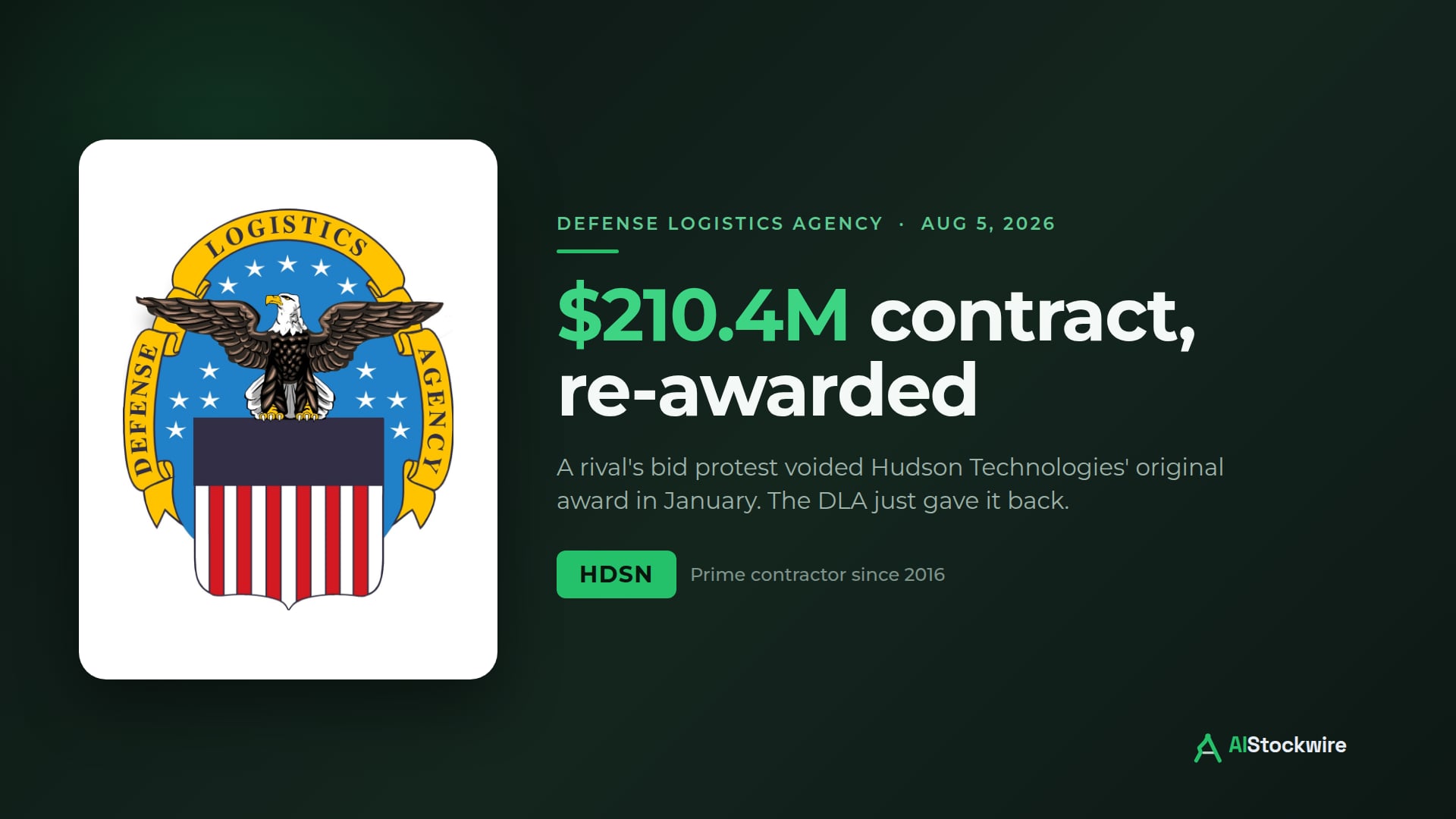
- The DLA re-awarded Hudson Technologies (HDSN) its industrial gas contract on August 5, at a $210.4M ceiling.
- A rival's bid protest voided the original October 2025 award in January. Hudson has worked under a bridge extension since July 29.
- The DLA was 15% of Hudson's 2025 revenue, or $38.2M. The award continues that work, it does not add to it.
- HDSN traded down to $5.90 after Q2 earnings, then as high as $7.00 once the award posted.
The Defense Logistics Agency has awarded Hudson Technologies (HDSN) a contract for industrial gas and cylinders with a maximum value of $210,399,912, according to the Defense Department's contract announcements for Wednesday, August 5. The award replaces contract SPE4AX-26-D-9003, which the DLA issued on October 22, 2025.
It was a competitive acquisition with three responses received. The contract is fixed-price with economic price adjustment, and indefinite-delivery, indefinite-quantity. It runs five years with one five-year option period, and the performance completion date is August 4, 2031. Using customers are the Army, Navy, Air Force, Marine Corps, Space Force and the DLA itself.
Hudson has held this work as prime contractor since July 2016.
What happened to the original contract
Hudson announced on October 22, 2025 that it had retained the contract after a competitive rebid, at about $210 million for the first five-year base period.
On January 30, 2026, Hudson disclosed that a competitor had filed a bid protest at the U.S. Court of Federal Claims, "challenging the DLA's evaluation of proposals and the contract award to Hudson Technologies." The DLA rescinded the award while it reviewed its evaluation. Hudson's filings don't name the competitor.
Kenneth Gaglione, president and chief executive officer of Hudson Technologies, said in that January release that "bid protests are a common occurrence in government contracting matters, and we are confident that Hudson is in the best position to ultimately receive this contract."
On May 28 the company disclosed a bridge modification from the DLA extending its existing agreement from July 29, 2026 to November 29, 2026, with options for two additional three-month extensions through February 28, 2027 and May 29, 2027.
| Date | Event | Status |
|---|---|---|
| Oct 22, 2025 | DLA awards rebid to Hudson | Awarded |
| Jan 30, 2026 | Competitor protests at Court of Federal Claims | Rescinded |
| May 28, 2026 | Bridge extension to Nov 29, 2026 | Interim |
| Aug 5, 2026 | DLA awards SPE4AX-26-D-9007 | Awarded |
How much the DLA is worth to Hudson
Revenue from the DLA totaled $38.2 million in 2025, $35.5 million in 2024 and $53.0 million in 2023, according to Hudson's annual report for 2025. The filing lists the DLA as accounting for greater than 10% of revenue in each of those three years, and for over 10% of accounts receivable at the end of 2025 and 2024.
Hudson reported total 2025 revenue of $246.6 million. That puts the DLA at 15% of the year.
The new ceiling of $210.4 million across a five-year base period averages $42.1 million a year. An indefinite-delivery, indefinite-quantity contract sets a maximum and an ordering period. It doesn't commit the government to buy the full amount.
Hudson's market capitalization was $265 million at Wednesday's close.
Why the stock fell before it rose
Hudson filed its second quarter results at 4:10 p.m. Eastern on Wednesday, ahead of the Defense Department's contract list. Revenue was $78.3 million, up 8% from $72.8 million a year earlier, with sales volume up 12% and selling prices down 6%. Net income was $4.9 million, or $0.12 per diluted share, against $10.2 million and $0.23 a year earlier.
| Q2 2026 | Reported | Year ago |
|---|---|---|
| Revenue | $78.3M | $72.8M |
| Gross margin | 26% | 31% |
| SG&A | $12.4M | $9.3M |
| Net income | $4.9M | $10.2M |
| Diluted EPS | $0.12 | $0.23 |
Revenue for the six months was $138.5 million, up 8% from $128.2 million, with net income of $5.3 million against $12.9 million. Hudson reported $25.6 million in cash and cash equivalents at June 30, and the release described the balance sheet as unlevered.
The company cut its margin target for the year, to "low-to-mid-twenty percent" from the "mid-twenty percent" it announced previously. The release cited subdued refrigerant pricing and inflationary pressure through the close of 2026.
Selling, general and administrative expenses rose to $12.4 million from $9.3 million. Hudson attributed part of the increase to "legal expenses incurred related to the Company's DLA contract."
HDSN closed the regular session at $6.21, down 1.7% on the day. It traded at $5.90 in the half hour after the earnings filing. Between 5:00 and 5:30 p.m. Eastern it reached $7.00, and it was at $6.45 by 5:41 p.m. Eastern. The stock's 52-week range is $4.64, set May 20, to $10.52, set September 15, 2025.
Hudson had not filed a separate announcement of the new award as of Wednesday evening. Its only Form 8-K on August 5 was the quarterly earnings release.
Rocket Lab (RKLB) rose after the Space Force awarded it a $266 million suborbital launch contract in July. Ondas (ONDS) gained 11.0% on August 3 after the Pentagon committed $1.3 billion to drone parts.
Gaglione, in Wednesday's earnings release: "Our selling season is underway and second quarter sales revenue and volume growth exceeded expectations despite significant headwinds in the quarter, including a continued trough in HFC market prices and inflationary pressures."
Sources
- U.S. Department of Defense, Contracts for Aug. 5, 2026
- Hudson Technologies, Update on status of Defense Logistics Agency contract, Form 8-K exhibit 99.1, January 30, 2026
- Hudson Technologies, Extension of contract with the DLA, Form 8-K exhibit 99.1, May 28, 2026
- Hudson Technologies, Second quarter 2026 results, Form 8-K exhibit 99.1, August 5, 2026
- Hudson Technologies, Annual report on Form 10-K for the year ended December 31, 2025
This is general market commentary and opinion, not investment advice. Markets can go down as well as up, and you can lose money. Always do your own research and consider speaking with a licensed financial professional before making any investment decision.