Key points
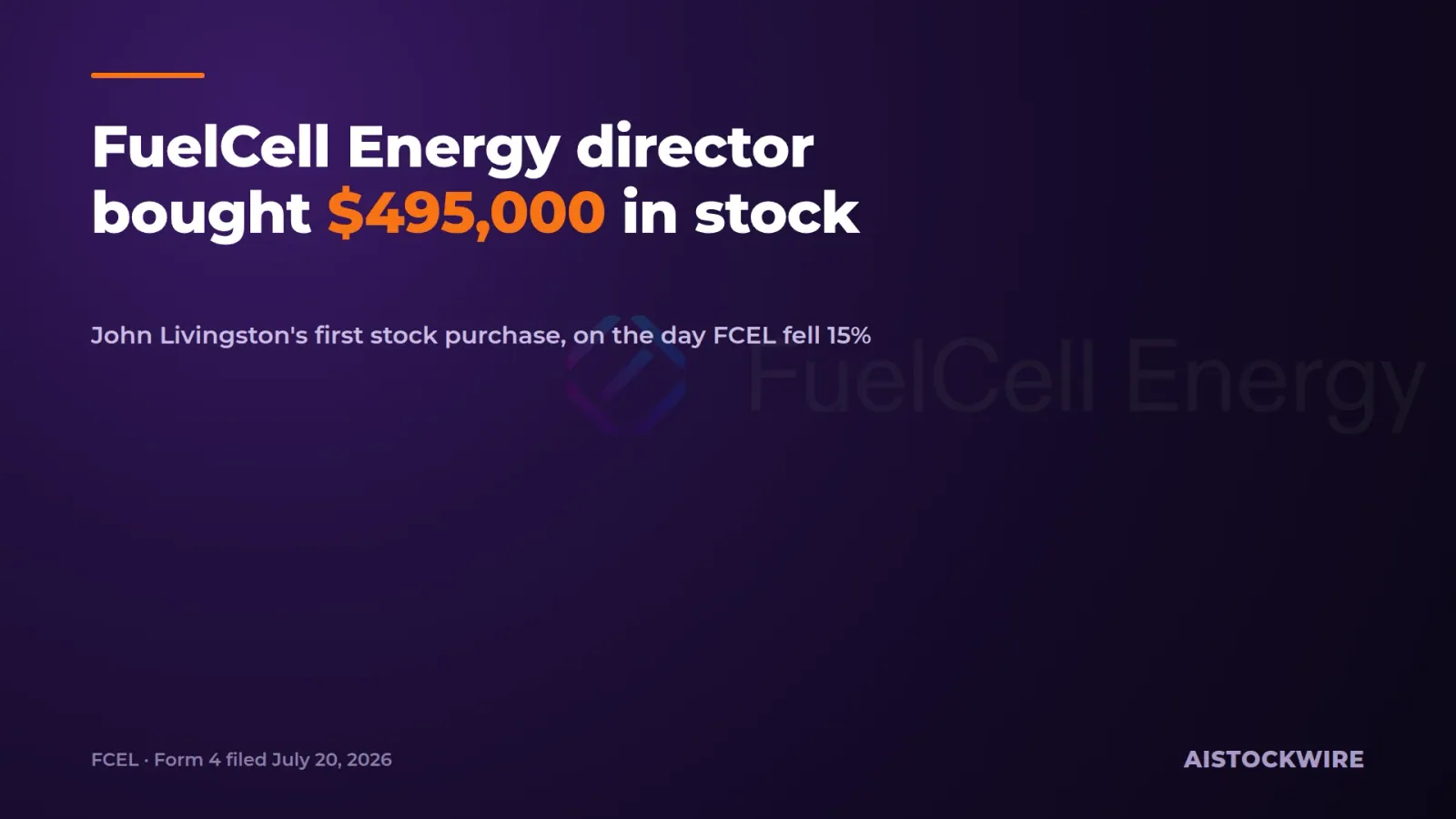
- FuelCell Energy (FCEL) director John Livingston bought 26,343 shares for $494,967 on July 16, his first stock purchase since joining the board in May.
- The buy landed on a day shares fell 15%, about a week after a $225 million stock offering diluted existing holders.
- Shares have since steadied near $18.50, close to Livingston's average cost, still roughly half of where they closed on June 30.
John Livingston joined the board of FuelCell Energy (FCEL) on May 19. Two months later, on a day the stock fell 15%, he wrote a personal check for just under $495,000 to buy more of it.
According to a Form 4 filed with the SEC on July 20, Livingston bought 26,343 shares of FuelCell Energy in the open market on July 16, paying a weighted average of $18.7893 a share, with individual fills between $18.71 and $18.79. The total came to $494,967. The filing is marked transaction code P for an open-market purchase, and it states plainly that the trade was not made under a Rule 10b5-1 plan, the prescheduled trading arrangement many executives use to avoid insider-trading questions. This was a decision Livingston made in real time, not an automatic buy set up months earlier.
It's also his first stock transaction. When Livingston joined the board, his initial ownership filing reported zero shares of FuelCell Energy common stock. The only paper he'd picked up since then was compensation, deferred stock units awarded in June for board service that carry no cost and no cash outlay. The July 16 purchase was the first money he put in himself.
Livingston isn't a fuel cell industry veteran. He spent more than 20 years at McKinsey & Co., advising industrial and technology companies on growth strategy, before founding and running Verve Industrial Protection, an operational-technology cybersecurity company that Rockwell Automation later acquired. Jason Few, FuelCell Energy's president and CEO, framed the appointment as adding expertise in the industrial technology environments the company is chasing as it courts data center customers.
A rough stretch before the buy
FuelCell Energy's stock had a wild few weeks leading up to this. On June 24, the company announced a strategic agreement with Fit Energy for up to 380 megawatts of clean power for data centers, a multi-phase deal starting with a paid 30-megawatt tranche. FuelCell Energy is one of several companies pitching fuel cells as power for AI data centers, alongside the nuclear and gas names in our look at AI's power problem. Shares ran from around $20 to a 52-week high of $37.88 intraday on June 30.
Then came the dilution. On July 7, FuelCell Energy priced an upsized public offering of 10,714,286 shares at $21 each, raising about $225 million through underwriters Citigroup and Barclays. That price sat roughly 45% below the stock's high from a week earlier, and shares fell hard on the news. Two days later, Siemens signed a memorandum of understanding to supply electrical infrastructure for FuelCell Energy's fuel cell systems on projects above 100 megawatts. "This collaboration enables us to deliver what the market has been asking for," said Shankar Achanta, FuelCell Energy's chief product and technology officer, on the tie-up. The good news didn't stop the slide. Shares kept falling through the following week.
Buying into a red day
July 16 was rough. FuelCell Energy opened at $19.57, dropped as low as $16.88 intraday, and closed at $17.26, down about 15% from the prior session. That's the day Livingston bought. His fills, between $18.71 and $18.79, landed above where the stock ultimately closed, meaning the shares kept sliding after he bought, not before.
The stock recovered some ground the next day, closing at $18.50 on July 17, and it's traded around there since. As of this writing, FuelCell Energy sits close to Livingston's average purchase price, well above its 52-week low of $3.78 but still roughly half of its $36.01 close on June 30.
What one buy does and doesn't tell you
An open-market purchase like this is different from the stock grants and option exercises that make up most of what shows up in insider filings. Livingston paid market price with his own money, on a day the stock was getting hit, right after the company diluted every existing shareholder to raise cash. That's a genuine signal of personal confidence.
It isn't proof of anything by itself. One director's $495,000 purchase doesn't offset a $225 million dilutive raise, and FuelCell Energy is still an unprofitable company with a stock that has swung between $3.78 and $37.88 in the past year. We broke down whether following insiders, hedge funds, or members of Congress into a stock actually beats the market in a separate look at the data. It depends heavily on which insider is buying and why. Full SEC filing history for the company is at FuelCell Energy's filings page.
For how prescheduled insider sales differ from decisions like this one, see our explainer on 10b5-1 trading plans.