Key points
- Drones are becoming central to modern warfare. Ukraine uses roughly 10,000 low-cost, attritable drones a month, and the Pentagon is copying that model with the Replicator initiative and a new $1 billion Drone Dominance program.
- The Pentagon's fiscal 2027 budget request includes nearly $75 billion for unmanned systems and counter-drone technology.
- Despite that backdrop, the six most-watched drone and drone-adjacent stocks, AeroVironment, Kratos, Red Cat, Ondas, Unusual Machines, and AIRO, are all down 45% to 65% from their 2026 highs.
- The gap comes down to hype running ahead of itself early in the year, plus real company-specific setbacks like AeroVironment losing a contract worth $1.7 billion in future revenue.
There's an odd gap sitting inside the drone sector right now, and it's worth naming plainly before getting into the numbers. Ukraine has been fighting with cheap, disposable drones that take out equipment worth many times their own cost, and the Pentagon has clearly noticed, asking for close to $75 billion next year alone for unmanned systems and counter-drone technology. And yet the six stocks most tied to that story, AeroVironment, Kratos, Red Cat, Ondas, Unusual Machines, and AIRO, are all down somewhere between 45% and 65% from where they traded earlier this year. Here's what's actually going on, and why the spending story and the stock prices have stopped agreeing with each other.
Why the Pentagon is betting big on drones
Ukraine's military has been producing and flying an estimated 10,000 attritable drones a month, cheap, disposable systems built to be lost in large numbers rather than protected like a traditional aircraft. Former Deputy Defense Secretary Kathleen Hicks has pointed to that exact model as the inspiration behind Replicator, the Pentagon's push to field thousands of autonomous systems quickly, explicitly framed as a way to counter China's advantage in sheer numbers of ships, missiles, and troops.
Replicator has not moved as fast as promised. The program's first phase aimed to field thousands of drones by August 2025 and instead delivered only hundreds, according to the Congressional Research Service. A second phase, Replicator 2, flips the problem around: instead of building drones to attack with, it funds counter-drone systems built to shoot down the same kind of cheap FPV drones that have devastated armor in Ukraine. The Pentagon made its first Replicator 2 acquisition on January 11, 2026.
Running alongside Replicator is a newer, more aggressive program called Drone Dominance: a $1 billion initiative under which 12 vendors are meant to deliver a combined 30,000 one-way attack drones at a target cost of about $5,000 each, with deliveries starting in early 2026. Zoom out further and the number gets bigger still. The Pentagon's fiscal 2027 budget request includes close to $75 billion for unmanned systems and counter-drone technology combined, one of the largest single line items tied to any emerging military technology right now.
The stocks got crushed anyway
Prices below are as of Friday, July 10, 2026, and will move.
| Stock | Price | Down from 2026 high |
|---|---|---|
| AeroVironment (AVAV) | $144.67 | -65% from $408.25 (Jan) |
| Kratos Defense (KTOS) | $48.17 | -64% from $134.00 (Jan) |
| Red Cat Holdings (RCAT) | $8.82 | -53% from $18.78 (Mar) |
| Ondas Holdings (ONDS) | $7.28 | -52% from $15.28 (Jan) |
| Unusual Machines (UMAC) | $18.82 | -45% from $34.36 (Jun) |
| AIRO Group (AIRO) | $6.27 | -55% from $13.80 (Jan) |
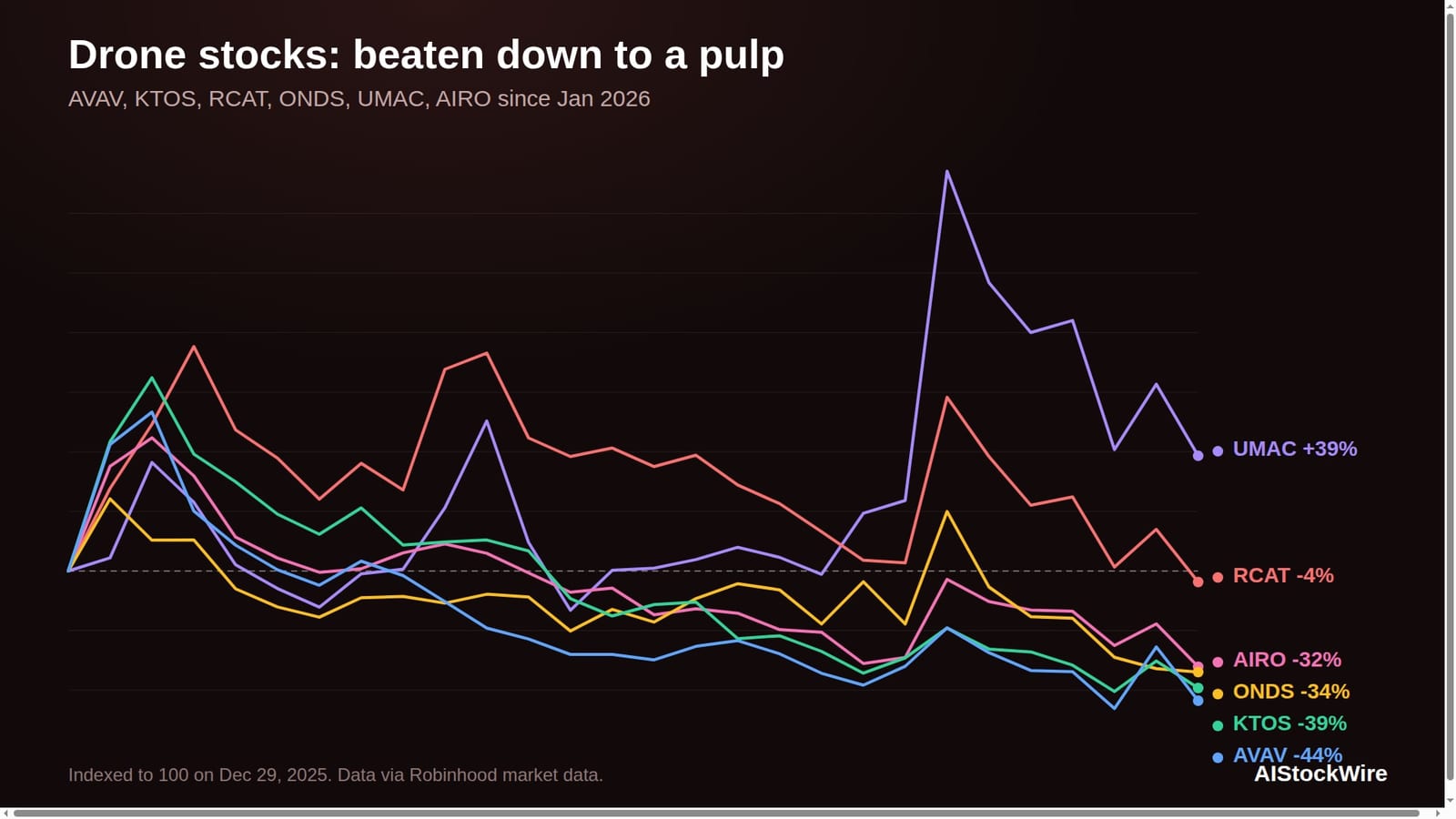
Most of that damage happened in two stages. Nearly every name on this list jumped hard in January, on the same story you just read: Ukraine's drone success and the early Replicator headlines. Prices ran ahead of actual revenue. Then investors started asking harder questions, about which of these companies turn a profit and which are still spending against contracts that haven't been signed yet. A few names also took real, specific hits on top of that. And because this group tends to trade as one, bad news at any single company tends to drag the other five down with it, even when their own numbers haven't changed.
1. AeroVironment (AVAV), the biggest drop
AeroVironment builds the small tactical drones and loitering munitions the US military actually carries into the field, including the Switchblade attack drone and the Puma reconnaissance drone. It added missile and space systems after merging with BlueHalo in 2025. It's the biggest name on this list and it has the biggest drop, down 65%, and the reason is specific: AeroVironment lost a contract worth roughly $1.7 billion in future revenue. The company still beat and raised its own fourth-quarter guidance in the same stretch, and new business is already offsetting part of that loss.
2. Kratos Defense (KTOS), the strongest backlog
Kratos makes the unmanned aerial target drones the military uses to train pilots and test air defenses, plus the Valkyrie combat drone and separate space, satellite, and hypersonics-testing businesses. It's down 64%, roughly in line with the rest of this group, even though its own numbers look solid. Kratos entered the second quarter with a backlog over $2 billion, about 72% of it already funded, and analysts project revenue growth above 20% a year for the next four years. Of the six companies here, Kratos has the most business already booked underneath its falling stock.
3. Red Cat Holdings (RCAT), a specific export risk
Red Cat Holdings makes small reconnaissance drones, including the Teal 2 and Black Widow, and won the US Army's Short Range Reconnaissance program as the sole supplier. It's down 53%, and part of that is just the same pressure hitting everyone on this list. Red Cat has one problem the others don't, though. China banned dual-use exports to the company directly, on top of the volatility that already comes with a small defense stock like this one.
4. Ondas Holdings (ONDS), the dilution story
Ondas Holdings is a little different from the rest. It doesn't only build drones, it builds the network they fly on. Its IronDrone platform handles the secure, real-time communication industrial and military drones need, and Ondas also owns drone-in-a-box hardware through its American Robotics subsidiary. Down 52%. Here dilution is the real story: Ondas paid for its $875.8 million acquisition of DZYNE Technologies partly with new shares. Its trading volume now runs many times higher than any other name on this list, which tells you something about how many shares are actually out there now.
5. Unusual Machines (UMAC), the smallest drop
Unusual Machines sits apart from the other five too, since it doesn't make finished drones at all. It supplies the parts: flight controllers, motors, FPV video systems, sold under its Fat Shark and Rotor Riot brands and marketed as US-made at a moment when the defense industry is trying to wean itself off Chinese-made components. Down only 45%, the smallest drop of the six. Worth knowing why: Unusual Machines peaked later than everyone else, in early June, not long after it landed a record $12.8 million contract to supply about 160,000 drone components to the Army.
6. AIRO Group Holdings (AIRO), the newest and most volatile
AIRO Group Holdings is the newest name here, public only since mid-2025, and the most spread out. It runs four businesses under one roof: tactical drones like the RQ-35 Heidrun reconnaissance system, avionics and flight-control systems, military pilot training on L-39 jets, and an electric air mobility unit aimed at cargo flights by 2027. Down 55%. Smallest company, newest listing, least trading history to compare it against. Any one of those three would be reason enough to expect bigger price moves than the rest of this list.
The case for these stocks
Set the January hype aside and the underlying demand hasn't gone anywhere. Ukraine's drone war is still the reference point every defense planner studies. Nearly $75 billion is a real number moving through a real Pentagon budget process, not a headline someone floated. Drone Dominance deliveries have barely started, and Replicator 2's counter-drone contracts only began in January. Most of what this spending is supposed to produce for these six companies hasn't happened yet.
The case against them
None of that erases the other side. Several of these companies still aren't profitable, and dilution shows up again and again in this group, not only at Ondas. Government contracts tend to sit on a balance sheet as backlog long before they turn into cash, and defense budgets slip more often than they move faster. Replicator's own missed 2025 target is proof of that. These six stocks also move as a pack. One dilution filing or one export ban and the other five feel it the same day, whether or not anything actually changed at their own businesses.
How to read this
None of this is a buy list. The Pentagon's numbers are real. Ukraine's shift toward cheap, disposable drones is real. And so is every one of these six drawdowns, for reasons as different as a single lost contract and years of steady dilution. What's actually unresolved is whether the spending story closes the gap with these stock prices, or whether it takes longer than anyone watching this space expects.
Sources
- Congressional Research Service, DOD Replicator Initiative: background and issues for Congress
- GovConWire, Drone Dominance, Blue Lists, and DAWG: inside the unmanned push
- Yahoo Finance / Investing.com, Drone stocks are down, but defense backlogs tell a different story
- Yahoo Finance, Unusual Machines' record Army drone parts deal
- Bloomberg, Drone maker AIRO's shares rise up to 291% after upsized IPO
- Related coverage: AeroVironment beats and raises after hours
- Related coverage: Ondas's $875.8 million DZYNE acquisition and dilution
- Related coverage: Drone stocks rally: AVAV, ONDS, RCAT
- Price data via Robinhood market data
This is general market commentary and opinion, not investment advice. Prices reflect closing levels as of Friday, July 10, 2026, and will move. Markets can go down as well as up, and you can lose money. Always do your own research and consider speaking with a licensed financial professional before making any investment decision.